3.1. Capacity-controller QoS Register Interface
Controllers, such as cache controllers, that support capacity allocation and usage monitoring provide a memory-mapped capacity-controller QoS register interface.
The capacity controller allocates capacity in fixed multiples of capacity units. A group of these capacity units is referred to as a capacity block. One or more capacity blocks can be allocated to a workload. When a workload requests capacity allocation, the capacity is allocated by using capacity units situated within the capacity blocks assigned to the workload. Capacity blocks can also be shared among one or more workloads. Optionally, the capacity controller might allow configuration of a limit on the maximum number of capacity units that can be occupied in the capacity blocks allocated to a specific workload.
|
For example, a cache controller allocates capacity in multiples of cache blocks. In this context, a cache block serves as a capacity unit, and a group of cache blocks forms a capacity block. A cache controller supporting capacity allocation by ways might define a capacity block to be the cache blocks in one way of the cache. |
The capacity allocation affects the decision regarding which capacity blocks to use when a new capacity unit is requested by a workload, but usually does not affect other operations of the controller.
|
For example, when a request is made to a cache controller, the request involves scanning the entire cache to determine if the requested data is present. If the data is located, then the request is fulfilled with this data, even if the cache block containing the data was initially allocated for a different workload. The data continues to reside in the same cache block. Consequently, the cache lookup function remains unaffected by the capacity allocation constraints set for the workload that initiated the request. Conversely, if the data is not found, a new cache block must be allocated. This allocation is executed by using the capacity blocks assigned to the workload that made the request. Hence, a workload might only trigger evictions within capacity blocks designated to it, but can access shared data in capacity blocks allocated to other workloads. |
| Offset | Name | Size | Description | Optional? |
|---|---|---|---|---|
0 |
|
8 |
No |
|
8 |
|
8 |
Yes |
|
16 |
|
8 |
Yes |
|
24 |
|
8 |
Yes |
|
32 |
|
|
Yes |
|
N |
|
8 |
Yes |
The size of the cc_block_mask register is determined by the NCBLKS field
of the cc_capabilities register but is always a multiple of 8 bytes. The
formula for determination of BMW is defined in 3.1.5. Capacity Block Mask (cc_block_mask). The offset N is
determined as 32 + BMW/8.
The reset value is 0 for the following register fields.
-
cc_mon_ctl.BUSYfield -
cc_alloc_ctl.BUSYfield
The reset value is UNSPECIFIED for all other registers fields.
The capacity controllers at reset must allocate all available capacity to RCID
value of 0. When the capacity controller supports capacity allocation per
access-type, then all available capacity is shared by all the access-type for
RCID=0. The capacity allocation for all other RCID values is UNSPECIFIED.
The capacity controller behavior for handling a request with a non-zero RCID
value before configuring the capacity controller with capacity allocation for
that RCID is UNSPECIFIED.
3.1.1. Capacity-controller Capabilities
The cc_capabilities register is a read-only register that holds the
capacity-controller capabilities.
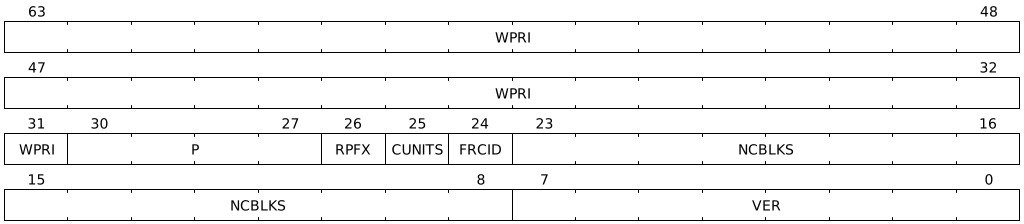
The VER field holds the version of the specification implemented by the
capacity controller. The low nibble is used to hold the minor version of the
specification and the upper nibble is used to hold the major version of the
specification. For example, an implementation that supports version 1.0 of the
specification reports 0x10.
The NCBLKS field holds the total number of allocatable capacity blocks in
the controller. The capacity represented by an allocatable capacity block is
UNSPECIFIED. The capacity controllers support allocating capacity in fixed
multiples of an allocatable capacity block.
|
For example, a cache controller that defines a way of the cache as a capacity block may report the number of ways as the number of allocatable capacity blocks. |
If CUNITS is 1, the controller supports specifying a limit on the capacity
units that can be occupied by an RCID in capacity blocks allocated to it.
If FRCID is 1, the controller supports an operation to flush and deallocate
the capacity blocks occupied by an RCID.
When the RCID-prefixed mode (RPFX) is 1, the controller operates in RPFX
mode. The parameter P (prefixed bits) indicates the number of least significant
bits of the MCID carried in the request that should be prefixed by the RCID. The
controller uses RCID in the requests along with P number of least significant
bits of the MCID to compute an effective MCID ([EMCID]). This MCID is used
to identify the monitoring counter. Legal values of P range from 0 to 12.
If RPFX is 0, P is set to 0, and the effective MCID is the same as the MCID
in the request.
3.1.2. Capacity Usage Monitoring Control
The cc_mon_ctl register is used to control monitoring of capacity usage by a
MCID. When the controller does not support capacity usage monitoring the
cc_mon_ctl register is read-only zero.

cc_mon_ctl)Capacity controllers that support capacity usage monitoring implement a usage
monitoring counter for each supported MCID. The usage monitoring counter can
be configured to count a monitoring event. When an event matching the event
configured for the MCID occurs, then the monitoring counter is updated. The
event matching might optionally be filtered by the access-type identifier.
The OP, AT, ATV, MCID, and EVT_ID fields of the register are WARL
fields.
The OP field is used to instruct the controller to perform an operation listed
in Table 2.
| Operation | Encoding | Description |
|---|---|---|
— |
0 |
Reserved for future standard use. |
|
1 |
Configure the counter selected by |
|
2 |
Snapshot the value of the counter selected by
|
— |
3-23 |
Reserved for future standard use. |
— |
24-31 |
Designated for custom use. |
The EVT_ID field is used to program the identifier of the event to count in
the monitoring counter selected by MCID. The AT field (See [AT_ENC]) is
used to program the access-type identifier to count, and its validity is indicated by the
ATV field. When ATV is 0, the counter counts requests with all access-type identifiers,
and the AT value is ignored.
| Event ID | Encoding | Description |
|---|---|---|
|
0 |
Counter does not count. |
|
1 |
Counter is incremented by 1 when a request with a
matching |
— |
2-127 |
Reserved for future standard use. |
— |
128-256 |
Designated for custom use. |
When the EVT_ID for a MCID is programmed with a non-zero and legal value by
using the CONFIG_EVENT operation, the counter is reset to 0 and starts counting
matching events for requests with the matching MCID and AT (if ATV is 1).
However, if the EVT_ID is programmed to 0, the counter stops counting.
A controller that does not support monitoring by access-type identifier can hardwire the
ATV and the AT fields to 0, indicating that the counter counts requests with
all access-types identifiers.
When the cc_mon_ctl register is written, the controller can perform
several actions that might not complete synchronously with the write. A write to
the cc_mon_ctl sets the read-only BUSY bit to 1, indicating the controller
is performing the requested operation. When the BUSY bit reads 0, the operation
is complete, and the read-only STATUS field provides a status value (see
Table 3 for details). Written values to the BUSY and the STATUS
fields are ignored. An implementation that can complete the operation
synchronously with the write may hardwire the BUSY bit to 0. The state of the
BUSY bit, when not hardwired to 0, shall only change in response to a write to
the register. The STATUS field remains valid until a subsequent write to the
cc_mon_ctl register.
STATUS |
Description |
|---|---|
0 |
Reserved |
1 |
The operation was successfully completed. |
2 |
An invalid operation ( |
3 |
An operation was requested for an invalid |
4 |
An operation was requested for an invalid |
5 |
An operation was requested for an invalid |
6-63 |
Reserved for future standard use. |
64-127 |
Designated for custom use. |
When the BUSY bit is set to 1, the behavior of writes to the cc_mon_ctl is
UNSPECIFIED. Some implementations ignore the second write, while others
might perform the operation determined by the second write. To ensure proper
operation, software must first verify that the BUSY bit is 0 before writing
the cc_mon_ctl register.
3.1.3. Capacity Usage Monitoring Counter Value
The cc_mon_ctr_val is a read-only register that holds a snapshot of the
counter that is selected by the READ_COUNTER operation. When the controller does not
support capacity usage monitoring, the cc_mon_ctr_val register always reads as
zero.

cc_mon_ctr_val)The counter is valid if the INV field is 0. The counter is marked INV if
the controller determines the count to be not valid for UNSPECIFIED reasons.
The counters marked INV can become valid in future.
The counter shall not decrement below zero. If an event occur that would otherwise result in a negative value, the counter continues to hold a value of 0.
|
Following a reset of the counter to zero, a capacity de-allocation attempts
to drive its value below zero. This scenario occurs when the Some implementations might not store the Set-sampling is a technique commonly used in caches to estimate the cache occupancy with a relatively small sample size. The basic idea behind set-sampling is to select a subset of the cache sets and monitor only those sets. By keeping track of the hits and misses in the monitored sets, it is possible to estimate the overall cache occupancy with a high degree of accuracy. The size of the subset needed to obtain accurate estimates depends on various factors, such as the size of the cache, the cache access patterns, and the desired accuracy level. Research [6] shows that set-sampling can provide statistically accurate estimates with a relatively small sample size, such as 10% or less, depending on the cache properties and sampling technique used. When the controller has not observed enough samples to provide an accurate
value in the monitoring counter, it might report the counter as being |
3.1.4. Capacity Allocation Control
The cc_alloc_ctl register is used to configure allocation of capacity to an
RCID per access type (AT). The OP, RCID and AT fields in this register
are WARL. If a controller does not support capacity allocation, then this
register is read-only zero. If the controller does not support capacity
allocation per access type, then the AT field is read-only zero.

cc_alloc_ctl)The OP field is used to instruct the capacity controller to perform an
operation listed in Table 5. Some operations necessitate the
specification of the capacity blocks to act upon. For such operations, the
targeted capacity blocks are designated in the form of a bitmask in the
cc_block_mask register. Additionally, certain operations require the capacity
unit limit to be defined in the cc_cunits register. To execute operations that
require a capacity block mask and/or a capacity unit limit, software must first
program the cc_block_mask and/or the cc_cunits register, followed by
initiating the operation with the cc_alloc_ctl register.
| Operation | Encoding | Description |
|---|---|---|
— |
0 |
Reserved for future standard use. |
|
1 |
Configure a capacity allocation for requests by
|
|
2 |
Read back the previously configured capacity
allocation for requests by |
|
3 |
Flushes the capacity units used by the specified
|
— |
4-23 |
Reserved for future standard use. |
— |
24-31 |
Designated for custom use. |
Capacity controllers enumerate the allocatable capacity blocks in the NCBLKS
field of the cc_capabilities register. The cc_block_mask register is
programmed with a bit-mask value, where each bit represents a capacity block for the
operation. If configuring capacity unit limits is supported (for example,
cc_capabilities.CUNIT=1), then a limit on the capacity unit that can be
occupied in the allocated capacity blocks can be programmed in the cc_cunits
register. If configuring limits is not supported, then the controller allows
the use of all capacity units in the allocated capacity blocks. A value of
zero programmed into cc_cunits indicates that no limits shall be enforced on
capacity unit allocation.
A capacity allocation must be configured for each supported access type by the
controller. An implementation that does not support capacity allocation per
access type can hardwire the AT field to 0 and associate the same capacity
allocation configuration for requests with all access types. When capacity
allocation per access type is supported, identical limits can be configured for
two or more access types, if different capacity allocation per access type is not
required. If capacity is not allocated for each access type supported by the
controller, the behavior is UNSPECIFIED.
|
A cache controller that supports capacity allocation indicates the number of
allocatable capacity blocks in
Some controllers allow setting a limit on capacity units in allocated capacity
blocks. In exclusive allocations, like for |
The FLUSH_RCID operation can incur a long latency to complete. However, the
RCID can submit new requests to the controller while it is being flushed.
Additionally, the controller is allowed to deallocate capacity that was allocated
after the operation was initiated.
|
For cache controllers, the The |
When the cc_alloc_ctl register is written, the controller might perform
several actions that might not complete synchronously with the write. A write to
the cc_alloc_ctl sets the read-only BUSY bit to 1, indicating the controller
is performing the requested operation. When the BUSY bit reads 0, the operation
is complete, and the read-only STATUS field provides a status value
(Table 6) of the requested operation. Values that are written to the BUSY and
the STATUS fields are always ignored. An implementation that can complete the
operation synchronously with the write might hardwire the BUSY bit to 0. The
state of the BUSY bit, when not hardwired to 0, shall change only in response
to a write to the register. The STATUS field remains valid until a subsequent
write to the cc_alloc_ctl register.
STATUS |
Description |
|---|---|
0 |
Reserved |
1 |
The operation was successfully completed. |
2 |
An invalid or unsupported operation ( |
3 |
An operation was requested for an invalid |
4 |
An operation was requested for an invalid |
5 |
An invalid capacity block mask was specified. |
6-63 |
Reserved for future standard use. |
64-127 |
Designated for custom use. |
When the BUSY bit is set to 1, the behavior of writes to the cc_alloc_ctl
register, cc_cunits register, or to the cc_block_mask register is
UNSPECIFIED. Some implementations might ignore the second write and others might
perform the operation determined by the second write. To ensure proper operation,
software must verify that BUSY bit is 0 before writing any of these registers.
3.1.5. Capacity Block Mask (cc_block_mask)
The cc_block_mask is a WARL register. If the controller does not support
capacity allocation, for example, NCBLKS is 0, then this register is read-only 0.
The register has NCBLKS bits, each corresponding to one allocatable
capacity block in the controller. The width of this register is variable, but
always a multiple of 64 bits. The bitmap width in bits (BMW) is determined by
the following equation. The division operation in this equation is an integer
division.
Bits NCBLKS-1:0 are read-write, and the bits BMW-1:NCBLKS are read-only zero.
The process of configuring capacity allocation for an RCID and AT begins by
programming the cc_block_mask register with a bit-mask value that identifies the
capacity blocks to be allocated and, if supported, by programming the
cc_cunits register with a limit on the capacity units that might be occupied in
those capacity blocks. Next, the cc_alloc_ctl register is written to request a
CONFIG_LIMIT operation for the RCID and AT. After a capacity allocation
limit is established, a request can be allocated capacity in the capacity
blocks allocated to the RCID and AT associated with the request. It is
important to note that some implementations might require at least one capacity
block to be allocated by using cc_block_mask when allocating capacity;
otherwise, the operation fails with STATUS=5. Overlapping capacity block
masks among RCID and/or AT are allowed to be configured.
|
A multiway set-associative cache controller that supports capacity allocation by
ways can advertise |
To read the capacity block allocation for an RCID and AT, the controller
provides the READ_LIMIT operation, which can be requested by writing to the
cc_alloc_ctl register. When the operation completes successfully, the
cc_block_mask register holds the configured capacity block allocation.
3.1.6. Capacity Units
The cc_cunits register is a read-write WARL register. If the controller does
not support capacity allocation (for example, NCBLKS is set to 0), this register
shall be read-only zero.
If the controller does not support configuring limits on capacity units that
may be occupied in the allocated capacity blocks (for example,
cc_capabilities.CUNITS=0), then this register shall be read-only zero. In such
cases, the controller allows the utilization of all available capacity units by
an RCID within the capacity blocks allocated to it.
If the controller supports configuring limits on capacity units that might be
occupied in the allocated capacity blocks (for example, cc_capabilities.CUNITS=1)
then this register sets an upper limit on the number of capacity units that
can be occupied by an RCID in the capacity blocks allocated for an AT. A
value of zero specified in the cc_cunits register indicates that no limit is
configured.
The sum of the cc_cunits configured for the RCID sharing a capacity block
allocation may exceed the capacity units represented by that capacity block
allocation.
|
When multiple For instance, consider a group of four The capacity controller might enforce these limits through various techniques. Examples include:
These methods are not exhaustive and can be applied either individually or in combination to maintain capacity unit limits. When the limit on the capacity units is reached or is about to be reached, the capacity controller can initiate additional operations. These could include throttling certain activities (for example, prefetches) of the corresponding workload requests. |
To read the capacity unit limit for an RCID and AT, the controller
provides the READ_LIMIT operation that can be requested by writing to the
cc_alloc_ctl register. When the operation completes successfully, the
cc_cunits register holds the configured capacity unit allocation limit.